The purpose of computation is insight, not numbers.
Richard Hamming
In this post I will show you how to make a simple (yet potentially insightful) model of a complex phenomenon observed in the real-world. To such end, I will use the recent COVID-19 Coronavirus Outbreak for our modelling exercise. But first, a short background…
Short background
One rabbit, 3 rabbits, 9 rabbits, 27 rabbits, …. this sequence represents exponential growth of a population (given that each rabbit creates 2 more rabbits per iteration). The way infectious diseases spread also exhibits exponential growth. Mathematically this can be represented as the differential equation 


In reality, the population will saturate due to the natural limits of the environment. To reflect this, the differential equation above is modified by the term 


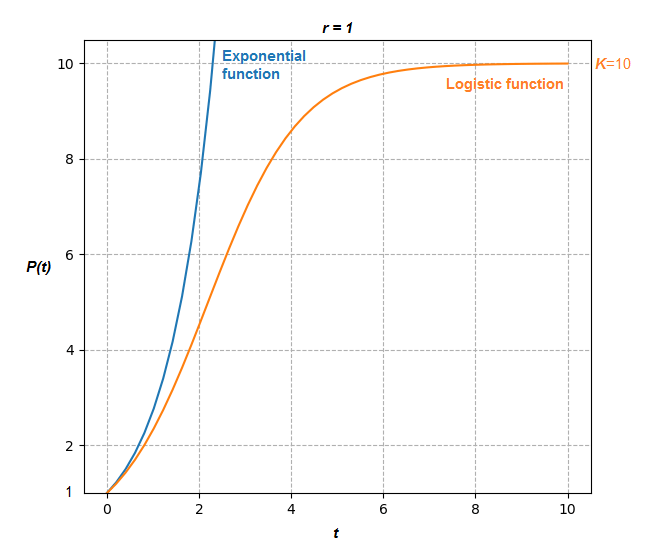
Clearly the population stabilizes at the value 

Infection model
For modelling the case of the COVID-19 Coronavirus Outbreak we want to fit the available data and determine when the infection started, when it will end, and how many people will be infected.
Disclaimer: this is merely an exercise and should not be considered as any meaningful predictions
So lets start by defining the following relevant variables:
is the number of new infected cases at a given time,
is the number of closed cases at a given time, i.e. they can no longer spread the infection (either healed or dead), and
is the sum total of infected cases over time.
Using the above variables we construct four equations:

the change in the active infected cases is equal to the change of new infected cases minus the change of closed cases.

this is the exponential growth part; new infected cases grow with increasing active infected cases.

closed cases are just equal the the new cases at a later time 

by integrating the new cases we can get the total number of infected cases.
Note that in the second equation we have 


Solving the differential equation
We want to calculate

where 

P_curr = P[-1] + dt*dPdt[-1]. Here I decided to append the lists P and dPdt each iteration, so the most recent time is at the last index, which is accessed by [-1].
The model and its solution can then be defined in Python as follows:
import numpy as np
def Infection_model(t_in,t0,t_close,r0,K):
    """
    t_in     : time at which to calculate [day]
    t0       : time at which infections started [day]
    t_close  : time until no longer infectious (closed case) [day]
    r0       : initial infection rate constant [/day]
    K        : maximum possible total number of cases (or carrying capacity)
    """
    # Model Parameters
    dt = 1/400 #Time step (Smaller is more accurate) [days]
    P0 = 1 #Initial infected population (always starts at 1)
    t_a = np.arange(0,t_in.max()+t0,dt) #Time range to calculate [days]

    # Define initial conditions and lists
    P, dPdt = ([P0],[0])
    P_new_list, P_closed_list = ([0],[0])
    P_total_cases_list = [P0]

    # Calculate
    for ind,t in enumerate(t_a): #For each time
        r = r0*(1-P_total_cases_list[-1]/K) #Infection rate constant (q used as "carrying capacity") [/day]
        dP_new = r*P[-1] #rate of new infected cases [/day]
        dP_closed = np.interp(t-t_close,t_a[:ind+1],P_new_list) if t >= t_close else 0 #rate of closed cases [/day]
        P_total_cases = P_total_cases_list[-1]+dt*dP_new #Current number of total cases

        #Numerical difference time stepping
        dPdt_curr = dP_new - dP_closed  #Change in population for current step [/days]
        P_curr = P[-1] + dt*dPdt[-1] #Population for current step (forward Euler method)

        #Append arrays
        P.append(P_curr)
        P_total_cases_list.append(P_total_cases)
        dPdt.append(dPdt_curr)
        P_new_list.append(dP_new)
        P_closed_list.append(dP_closed)

    t_a = np.append(t_a,t_a[-1]+dt) #Include the time for the last calculated point as well
    return P_new_list, P_closed_list, P_total_cases_list, t_a
A lot of it is self-explanatory with the comments. One noteworthy thing is that for calculating closed cases I use a linear interpolation routine. This is necessary for the curve fitting algorithm because there needs to be a finite change in the objective function with a change in the parameter t_close (this is evidenced by the result that the estimated value is the same as the guessed value). Otherwise, for plotting simply using P_new_list[-int( instead of t_close // dt + 1)]np.interp(...) is much faster.
Data fitting
Lets have a look at the available data that we want to fit:

We want to fit not only the total cases but the new cases and closed cases as well because those parameters will provide more information about the rate constant 
To fit the data we will use the scipy routine curve_fit. This routine minimizes the sum of squared residuals for non-linear functions with respect to the fitting parameters (also called non-linear least squares). The first three arguments are the model function (Infection_model(t_in,t0,t_close,r0,K)), the independent variable (time), and the dependent variable. The dependent variable here is
def Infection_model_fit(t_in,t0,t_close,r0,K):
    P_new_list, P_closed_list, P_total_cases_list, t_a = Infection_model(t_in,t0,t_close,r0,K)
    #Interpolate to get points exactly at time t_in
    P_total_cases_list = np.interp(t_in+t0,t_a,P_total_cases_list)
    P_new_list = np.interp(t_in+t0,t_a,P_new_list)
    P_closed_list = np.interp(t_in+t0,t_a,P_closed_list)
    return np.append(P_total_cases_list,np.append(P_new_list,P_closed_list)) #Three arrays appended into one for fitting
Note how I append the three arrays together into one. Now we can call the curve fitting routine as follows:
day = np.arange(0,len(tot_cases)) #Time [day]
pguess = [20,7,0.4,8e4] #Guess parameters for the fitting routine [t0,t_close,r0,K]
popt, pcov = curve_fit(Infection_model_fit, day, np.append(np.append(total_cases,daily_cases),closed_cases), pguess)
popt is the optimally determined parameters for minimizing the least-squares and pcov is the covariance matrix of those parameters, which we will use to estimate the error in the parameters later. Again, note how the input data is appended into a single array. The result of the fitting is as follows:
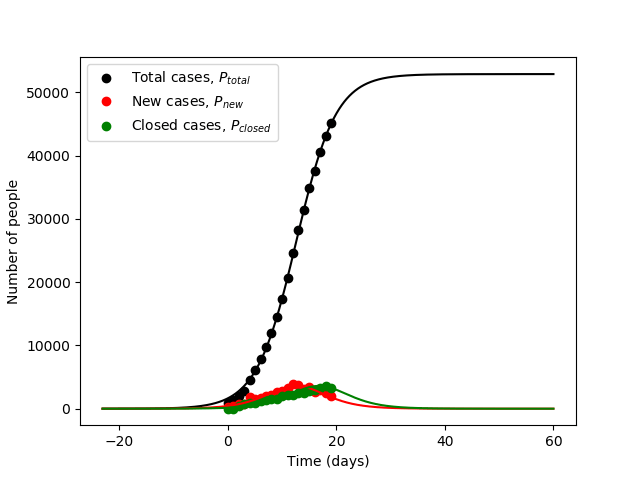
Looks good! The optimal parameters are determined as follows:
- Time when the infection started,
days (before 1st measured data)
- Time until closed case,
days
- Initial infection rate constant,
/day
- Maximum possible total number of cases (or the carrying capacity),

What can we get from this?
First of all, the 1st measured data was on January 22, 2020, and given the estimate of 
The estimate of the transmission rate 

On a technical note, observe that the total cases of the fitted curve never reaches the 
In conclusion, using a rather simple model and easily accessible data from the internet, we get a rough estimate for the dynamics of this viral outbreak. However, I must emphasize that this is merely an exercise and should not be considered as any meaningful predictions. Interpret at your own risk! Moreover, even small deviations in the predictions can really change the outcome, which is why more serious modelling is necessary.
Error Analysis
You may have noticed the error estimates in the parameters above. We got them from the covariance matrix that the curve_fit routine has calculated for us. The square-root of the diagonal components of this matrix give the standard deviation of the parameters: np.sqrt(np.diag(pcov)). Now that we know the errors, it is more interesting to see how the curve changes by sampling the parameters with the given uncertainty. But wait! Lets have a look at our covariance matrix (pcov):

You may notice large non-zero off-diagonal terms, this means there is some correlation between the parameters and we can not use a basic normal distribution. In order to sample the parameters properly given the covariance matrix we need to use the multivariate normal distribution. In Python this can be easily done with: np.random.multivariate_normal(mean=popt,cov=pcov).
To have a good visual representation of how the infection model curve looks with the generated random samples – I will generate 300 curves with a transparency so that the regions that are most overlapped (closer to the mean) appear darkest and the outliers appear lightest. The resulting curves, given one standard deviation in the parameters, are as follows:
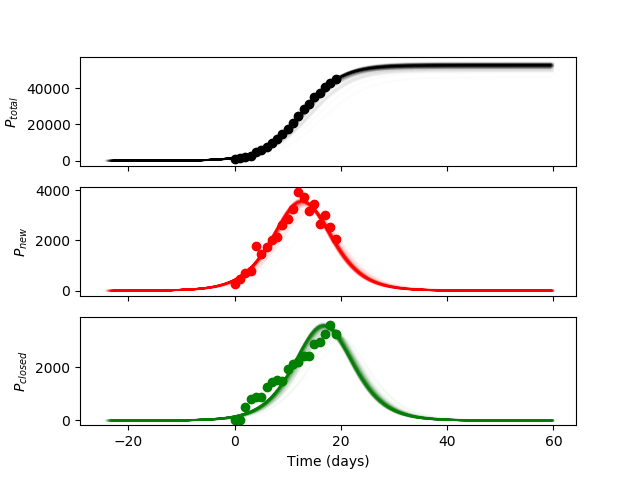
As you can see, most of the generated curves are clustered very tightly, indicating that the estimated variance in the fitting routine is very small for the fitted parameters. It should be mentioned that despite the small uncertainty estimate in the fitting parameters this does not indicate that:
- The fitted parameters accurately reflect the real situation (due to differences in model-reality dynamics)
- The fitted parameters determined from the non-linear least squares routine found a global minimum instead of a local minimum
Point 1 can be addressed by making a more complex model such as incorporating a model of how people travel around the world (at the expense of time). Point 2 is difficult to address since non-linear least squares fitting does not guarantee a global minimum but a reasonable approach would be to try various starting guess parameters within reasonable limits to see if it converges on a different solution (outside of the variance shown above).

Also my YouTube channel for AI related projects.
 Code Wanderer